

If your Zoom calls were dropping and uploads were crawling on April 9, 2026, you weren’t imagining it. A significant internet disruption hit Thailand and parts of Southeast Asia, triggered by submarine cable maintenance and traffic rerouting through Singapore. For digital nomads and expats whose livelihoods depend on a stable connection, it’s been a frustrating few days — and it’s part of a bigger story worth understanding.
Table of Contents
Full stabilisation is expected by April 13. Here’s what happened, why, and how to stay productive in the meantime.
Starting April 9, connectivity across Thailand and Southeast Asia degraded noticeably due to submarine cable maintenance and forced traffic rerouting — particularly affecting routes through Singapore. When primary cable paths go down, operators divert traffic to backup routes. Those backups are longer, often already near capacity, and quickly become congested. The result: services that stay technically online but perform erratically.
Expect occasional timeouts, inconsistent app performance, and worse slowdowns during peak hours (mid-morning and evenings). Connectivity improved by April 10, but networks remain on rerouted paths. Full resolution is expected by April 13, 2026.
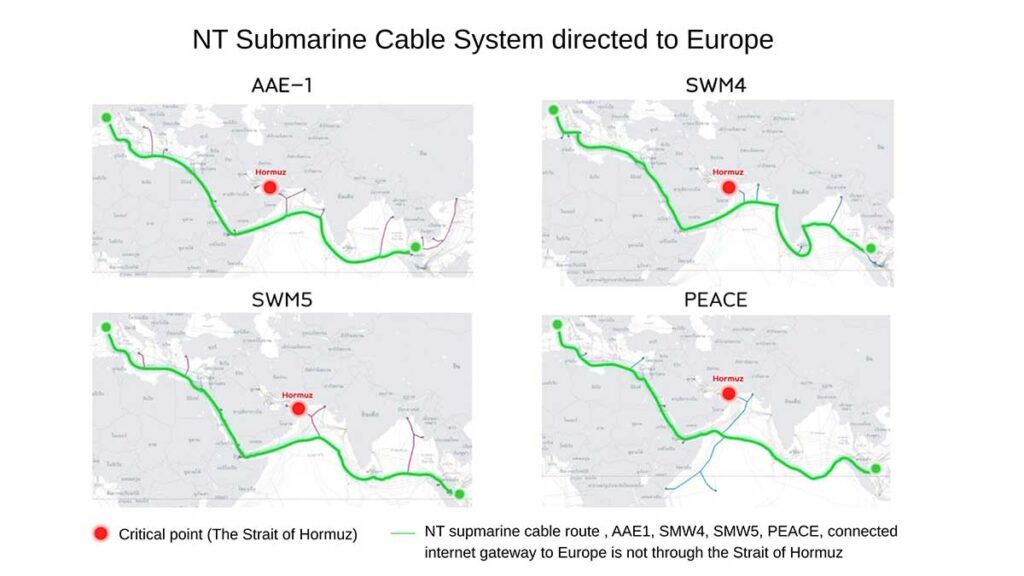
The Red Sea corridor carries roughly 17% of global internet traffic between Asia, Europe, and Africa — and it has been under sustained stress from geopolitical conflict. In early 2024, a Houthi-targeted vessel sank in the Red Sea, damaging three major cables and disrupting around 25% of traffic between Asia, Europe, and the Middle East. In September 2025, two more critical systems — SEA-ME-WE 4 (SMW4) and IMEWE — were severed near Jeddah. SMW4 directly connects Thailand, Malaysia, and Singapore to Europe. When it’s damaged or congested with rerouted traffic, users across Thailand feel it.
Repairing undersea cables is slow and expensive — each fix costs USD 1–3 million and can take weeks or months, depending on depth, weather, and geopolitical access. That’s why congestion from a single incident can ripple across the region for extended periods.
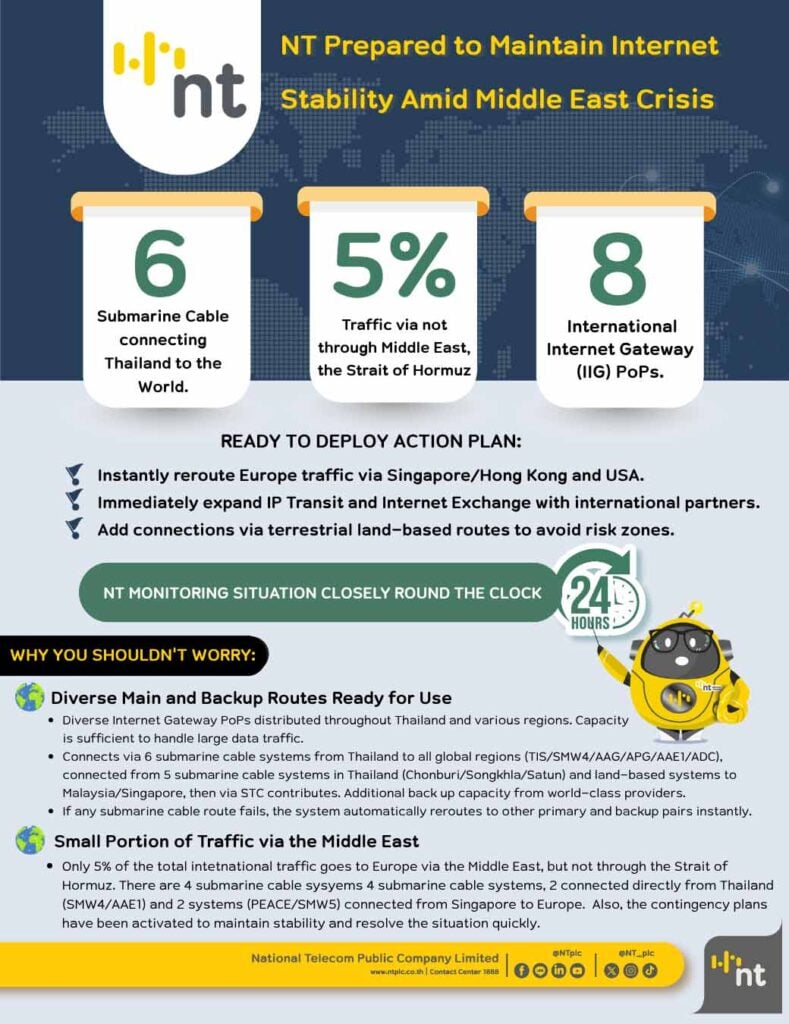
Less than you might think. National Telecom PLC (NT) confirmed in March 2026 that Thailand’s services remain stable and are not directly affected by the Strait of Hormuz situation. Key facts: only ~5% of Thailand’s international traffic routes toward Europe, most traffic runs on Asia-Pacific paths that bypass the Red Sea entirely, and full terrestrial and submarine backup systems are in place.
The real risk is secondary congestion — when regional rerouting floods shared infrastructure like Singapore’s hubs, Thai users experience slowdowns even when no local cable is damaged. That’s what happened on April 9. Thailand didn’t lose its cables; it absorbed the congestion from surrounding regions, compensating for theirs.
Thailand is one of the world’s top remote work destinations — the DTV visa has cemented that. But disruptions like this week’s are a sharp reminder of the infrastructure reality underlying that lifestyle. The tools that suffer most under high-latency, congested routes are exactly the ones remote work runs on:
For freelancers on deadlines or anyone mid-project, even a half-day of unreliable connectivity is a real business risk. Expats dealing with DTV admin and digital submissions can also be caught out — for a full guide on managing that process, see our Destination Thailand Visa guide for remote workers.
AIS, DTAC, and True Move’s 4G/5G networks run on different infrastructure from fixed-line broadband. During cable disruptions — which affect international routing, not domestic mobile towers — your phone’s hotspot may actually outperform your home fibre. Prepaid data plans run 200–1,500 THB, depending on allowance.
Consumer ISP connections share bandwidth and are the first to degrade. Business-grade dedicated fibre — the kind coworking spaces run — holds up better. In Phuket, Denz Coworking Café runs gigabit fibre above Patong with dedicated uplinks. See our coworking vs. coffee shops comparison for more on why that difference matters.
Congestion spikes at 9–11 am and 7–10 pm when local and international traffic overlap. If your schedule allows, front-load video calls and large uploads before 8 am.
Unless you need it for genuine security reasons, VPNs add routing hops and encryption overhead that compound latency on already-congested paths. Switch it off during the disruption window and restore it once routes normalise.
NetBlocks and the Internet Society Pulse Platform track real-time connectivity by country and network. Use them to confirm whether the issue is regional or local before spending an hour rebooting your router.

Q: Is the war in the Middle East directly affecting Thailand’s internet?
Not directly. Thailand’s state telecom NT confirmed that only ~5% of international traffic routes toward Europe, and it’s not passing through high-risk corridors. The impact is secondary: regional rerouting creates congestion on shared infrastructure that Thailand’s connections pass through.
Q: How long will this disruption last?
Full stabilisation is expected by April 13, 2026. Some peak-hour instability may continue until routes are fully restored to their normal optimised paths.
Q: Which ISP is most reliable in Phuket during disruptions?
No consumer ISP has a clear edge — disruptions affect the international routing layer, not the individual provider. The meaningful distinction is consumer broadband (more exposed to congestion) vs. dedicated business fibre. Mobile data on 5G can also outperform fixed-line during international congestion events.
Q: Will this get worse over time?
Geopolitical risk to undersea cables is real and increasing — 2024 saw a record 46 cable incidents globally. But new cables are also coming online, including several serving Southeast Asia in 2025–2026, which will add meaningful redundancy. The structural picture is gradually improving even if near-term disruptions remain a reality.
The April 2026 disruption is a useful reminder that remote work in Thailand — for all its advantages — sits on global infrastructure that’s not immune to geopolitical turbulence. The good news is Thailand’s networks are well-managed, the current situation has a clear resolution timeline, and the practical workarounds are straightforward.
Get a backup SIM. Know where your nearest coworking space is. Avoid peak hours for anything mission-critical. Do those three things, and a disruption window like this becomes an inconvenience, not a crisis. Full resolution is expected by April 13 — after that, Phuket goes back to being one of the best-connected places in the world to get work done.